Sustainability management
ESG management at STRABAG SE

Group-wide sustainability management
The requirements for sustainable business practices vary across STRABAG’s different business segments and divisions. Our central ESG management team works to systematically implement external requirements, promote group-wide solutions and integrate sustainability aspects into processes and decision-making. The focus here is on core business activities and their continuous development.
Governance structure
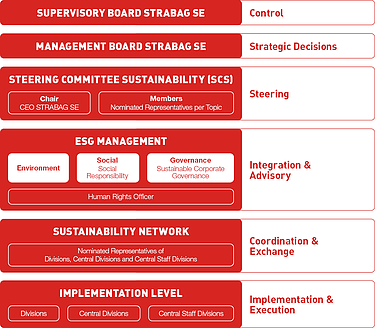
To establish successful sustainability management and embed our ESG objectives within our core business, we need a structure that defines leadership and accountability and involves all representatives across the Group. Our governance structure is designed to support the operational units, as well as the Group staff and central functions, in putting the sustainability strategy into practice. In addition, the governance structure serves to identify the impacts, risks and opportunities facing STRABAG at an early stage, in the spirit of forward-looking ESG risk management. This enables countermeasures to be developed and implemented at an early stage.
Through short lines of communication and decision-making, we involve representatives from all Group units with diverse areas of expertise. The ESG management team works closely with both the Sustainability Network and the Sustainability Steering Committee. Incorporating different perspectives and the associated transfer of knowledge is crucial to achieving our strategic sustainability goals. Regular consultation and reporting to the STRABAG SE Management Board and the STRABAG SE Supervisory Board complete the governance structure.
-
Supervisory Board of STRABAG SE
The Supervisory Board acts as the controling body of STRABAG SE. It is involved in various decision-making processes on a regular and ad hoc basis. The focus is on key business developments and risk analyses. The Management Board of STRABAG SE reports to the Supervisory Board at least once a year on topics such as health, safety and wellbeing, anti-corruption and sustainability. In addition, the Supervisory Board is informed about sustainability developments in an annual ESG update.
-
Management Board of STRABAG SE
The Management Board sets the strategic framework – including for sustainability management – and therefore makes decisions in accordance with the rules of procedure. In particular, projects that exceed a certain budget or scope are approved by the Management Board. To ensure the objectives of the sustainability strategy are continuously advanced, sustainability is a standing item on the agenda at every Management Board meeting. During these meetings, various topics relating to ESG management are raised and discussed. Since 2026, selected ESG criteria have also been taken into account in management remuneration and are thus more closely integrated into corporate governance.
-
Sustainability Steering Committee
The Sustainability Steering Committee, or SCS for short, governs the Group-wide sustainability management. It is chaired by the CEO of STRABAG SE. The SCS is made up of representatives from all of STRABAG's business divisions and largely reflects our value chain. The representatives on the SCS are responsible for specific topics. The SCS is actively involved in achieving the strategic sustainability goals and helps to shape the necessary policies and frameworks. Where appropriate, these are submitted to the Management Board as recommendations.
-
ESG Management
Central ESG management covers a wide range of areas and is therefore handled by various departments within the Group. Together, these departments are responsible for ensuring consistent and coordinated sustainability management. ESG management reports directly to the CEO of STRABAG SE and maintains dialogue with all bodies within the ESG governance structure. Sustainability management issues are strategically embedded, considered from a long-term perspective and supported by senior management.
-
Sustainability Network
All Group units are represented in the Sustainability Network by nominated representatives. The network facilitates a cross-organisational exchange of experience and knowledge, with a focus on best practices. The representatives contribute their specific expertise and are responsible for monitoring sustainability projects and targets within their respective units.
-
Implementation by the Group, Central and Central Staff Divisions
In order for our sustainability strategy to be implemented in our core business, we need the close cooperation and commitment of our operational business units as well as the Central Staff and Central Divisions. Together with experts from the various areas of STRABAG, projects are planned, further developed and rolled out onto our construction sites. In many business units, dedicated sustainability units are responsible for implementation.
Stakeholder Engagement
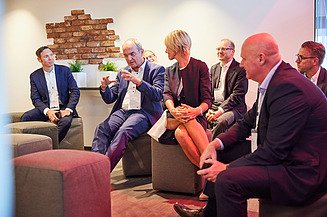
We have a range of formats for engaging with our stakeholders, which enable individualised and targeted forms of collaboration depending on the context and requirements. Internal stakeholders are involved, for example, through staff appraisals, the review of workplace accidents or various innovation management programmes. STRABAG also promotes dialogue with various external interest groups. Our particular focus is on our clients and contracting authorities, investors, suppliers and affected communities. Furthermore, we maintain contact with universities and the media, political institutions and NGOs. A range of engagement and dialogue formats are selected to encourage exchange between STRABAG and these stakeholder groups.
- Investors are informed in the course of the Annual General Meeting. The format also serves to answer open questions from investors. Information and questions about STRABAG's sustainability strategy are of great relevance here.
- The Strategic Update takes place on an ad hoc basis, during which STRABAG’s investors are informed about strategic developments.
- STRABAG's participation in specialist conferences and trade fairs promotes dialogue with peers and experts on various topics.
- STRABAG plays an active role in various bodies, such as the German Construction Industry Association (Hauptverband der Deutschen Bauindustrie), as well as in initiatives specifically focused on sustainability, such as the Stiftung KlimaWirtschaft, and engages in discussions on current developments within the sector.
- To gather and discuss different perspectives on STRABAG’s sustainability issues, we regularly organise the STRABAG Stakeholder Dialogue, where internal and external stakeholder groups engage in dialogue with one another.
Memberships & Initiatives

STRABAG is a supporting organisation of the Stiftung KlimaWirtschaft
Climate protection needs commitment: STRABAG SE sets an example for corporate responsibility in climate protection
The Stiftung KlimaWirtschaft actively promotes compliance with and implementation of the European and German climate targets. Since the beginning of 2023, STRABAG SE is now part of this alliance.The focus of the cooperation is on the circular economy, sustainable building materials and CO2-saving processes in the construction industry.

STRABAG SE participates in the Forum Alpbach
The Alpbach Forum offers a valuable platform for interdisciplinary exchange and the development of new ideas for a strong and democratic Europe.

Back in 2024, as part of the ‘Circular Economy in the Construction Industry’ lab, STRABAG SE brought together a diverse group of 30 participants to develop practical solutions to the challenges of the green transition in the construction sector. This led to the production of a joint policy paper on the circular economy.

Position paper on the circular economy